
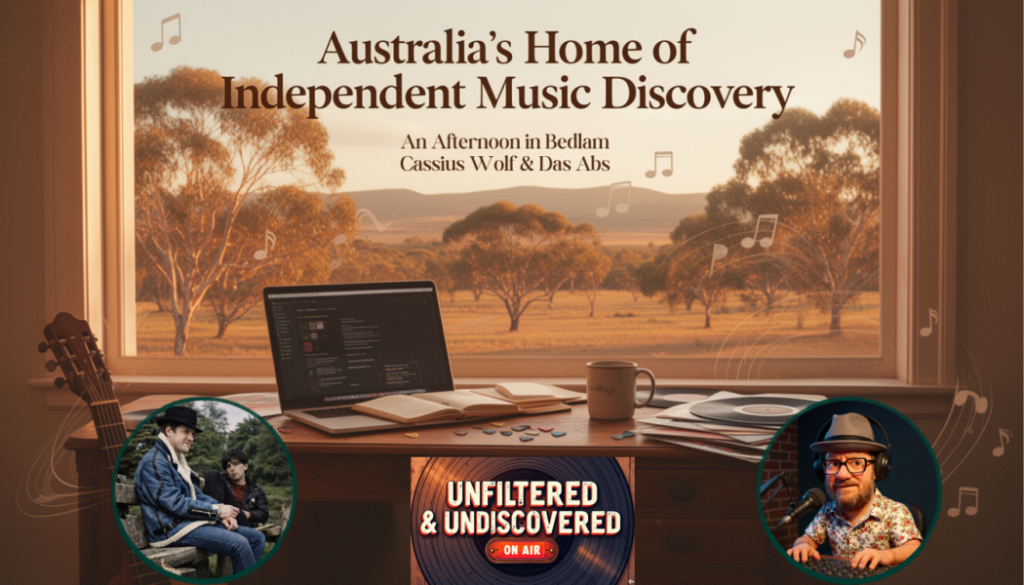
What happens when two teenagers who started making music together in the late 1970s rediscover their old cassette recordings more than four decades later?
You get An Afternoon in Bedlam.
For Braggy’s latest music discovery, we went somewhere a little different — back to the post-punk and new wave era and into the archives of Cassius Wolf and Das Abs.
What started as old cassette demos has become a surprisingly ambitious concept album that reaches back to the late 1970s and early 1980s while asking some very contemporary questions.
Welcome to Unfiltered & Undiscovered — Australia’s Home of Independent Music Discovery.
It Started When They Were 11
Cassius Wolf and Das Abs first came together as kids.
We’re talking about the late 1970s.
The post-punk and new wave movements were emerging, and bands such as The Cure, Echo & the Bunnymen, Orchestral Manoeuvres in the Dark and The Clash were changing the sound of popular music.
It was an era where experimentation was everywhere.
And these two young musicians were soaking it all in.
They spent their formative years around bars, dance halls and the music of the era.
Then, like happens to so many musicians, life moved on.
But the music didn’t disappear completely.
It was sitting there on cassette.
Waiting.
The Cassette Archive
Fast forward several decades and the pair went digging through their archives.
They found their old cassette decks, demos and recordings from those early days.
Instead of simply treating them as nostalgic artefacts, they decided to bring them back to life.
And that’s where things get particularly interesting.
Both musicians have strong technical backgrounds and their own home studio capabilities.
They were able to restore the old recordings, enhance them, add new material and combine the original ideas with modern production techniques.
The result is An Afternoon in Bedlam.
It’s not simply an old album released late.
It’s an album that exists somewhere between two eras.
The original recordings carry the character of another time, while the modern production gives the material a new life.
Welcome to Bedlam
The title An Afternoon in Bedlam isn’t simply a quirky name.
It comes from Bethlehem Hospital, the historic institution in England that became infamous for its treatment of people experiencing mental illness.
The institution became known as “Bedlam”, a word that eventually entered everyday language as a description for chaos and disorder.
But the history behind the word is much darker.
People were confined together under appalling conditions, and, incredibly, members of the public could pay to come and observe patients.
The album takes that disturbing history and uses it as a starting point for thinking about society today.
From Bedlam to the Internet
This is where An Afternoon in Bedlam becomes more than a retro musical exercise.
The album explores the idea that society has always had a tendency to single people out because they’re different.
Centuries ago, that could mean placing people in an institution and turning their suffering into entertainment.
Today, the mechanisms may be different.
But the tendency to point at people who don’t fit the expected mould can still exist.
And social media and online communities can sometimes amplify that behaviour.
The album therefore uses a historical concept to explore a very modern problem.
That’s an ambitious idea.
And it’s one that gives the music considerably more weight than simply saying:
“Remember the 1980s?”
The Sound of Another Era
Musically, Braggy heard plenty of familiar reference points.
There’s a strong The Cure influence in places, along with the post-punk and new wave sounds of the period.
There’s also a little of The Clash, particularly when the album moves towards reggae-influenced territory.
That’s an important connection because punk and reggae were closely connected during that era, with artists finding common ground in their rebellious spirit and social commentary.
Then there’s a touch of U2 in some of the tracks.
And Australian listeners may hear another familiar influence — Mental As Anything? No.
For Braggy, there’s a distinctly Australian connection to the early synth-and-guitar sound that recalls Mi-Sex.
The result is an album that refuses to sit neatly inside one genre.
It’s post-punk.
It’s new wave.
It’s guitar-driven.
It’s electronic.
There are reggae influences.
And it’s unmistakably shaped by the musical era in which these two artists first began creating.
“Another Girl”
One track Braggy singled out was “Another Girl.”
There’s a definite U2-like quality to the track, adding another dimension to the album’s sound.
It’s another example of how the album moves between influences rather than locking itself into one particular sound.
That variety helps prevent An Afternoon in Bedlam from becoming repetitive.
“The Sound of Guns”
Then there’s “The Sound of Guns.”
This is where Braggy hears the influence of The Clash.
The reggae elements are particularly noticeable, bringing another piece of the late-70s musical landscape into the album.
Again, it’s not simply imitation.
The interesting part is hearing how those old influences have been reconstructed and combined with modern production.
Old Ideas, New Technology
Perhaps the most fascinating aspect of An Afternoon in Bedlam is the way the old and new technologies coexist.
The original cassette recordings provide the foundation.
Modern studio technology allows those recordings to be restored, enhanced and expanded.
It’s almost like opening an old time capsule and discovering that it still has something to say.
And that makes the album feel authentic.
It’s not two musicians trying to manufacture a retro sound decades later.
They were actually there.
They were making those recordings when that musical culture was happening.
Now they’re taking those ideas and giving them another life.
Creativity Doesn’t Have an Expiry Date
But there’s another reason Braggy connected so strongly with this album.
Cassius Wolf and Das Abs are part of what they describe as the PCOR movement, which celebrates artists continuing to pursue creative ambitions later in life.
And there’s something powerful about that idea.
We often talk about emerging artists as though creativity has an age limit.
Young artists are encouraged to chase their dreams.
Older artists are sometimes expected to step aside.
Why?
Why should creativity belong to the young alone?
It doesn’t.
Music doesn’t suddenly stop being meaningful because you’ve reached a certain age.
Neither does writing.
Neither does painting.
Neither does filmmaking.
Neither does anything that allows people to express themselves creatively.
In fact, decades of experience can provide an entirely different perspective.
This Is What Music Discovery Is About
This album is exactly the kind of discovery that makes Unfiltered & Undiscovered interesting.
If you were simply searching for “new music”, you might never expect to find two musicians revisiting recordings they first made as teenagers in the late 1970s.
But that’s the beauty of music.
There are stories everywhere.
Some artists are emerging.
Some are reinventing themselves.
Some are returning after decades away.
Some have been making music all their lives and simply haven’t found your ears yet.
Our job is to help you find them.
Braggy’s Verdict
Braggy’s reaction was pretty clear.
He loved it.
It’s nostalgic without being trapped in nostalgia.
It’s rooted in the sounds of the late 1970s and early 1980s but produced with modern technology.
And underneath the music is a concept that remains relevant.
How do we treat people who are different?
And perhaps an even bigger question:
Why do we ever stop creating?
Discover “An Afternoon in Bedlam”
If you’re a fan of post-punk, new wave, The Cure, The Clash, U2, Australian synth-rock or simply music with a story behind it, An Afternoon in Bedlam deserves a listen.
Don’t approach it simply as an exercise in nostalgia.
Listen to what Cassius Wolf and Das Abs are doing with those old ideas.
Listen to how the cassette recordings have been transformed.
And listen to the questions underneath the music.
Because An Afternoon in Bedlam isn’t really about looking backwards.
It’s about taking something from the past and asking what it can tell us about now.
Unfiltered & Undiscovered — Australia’s Home of Independent Music Discovery.
We’re here to find the music, stories and artists you might otherwise miss.
And this one?
Braggy reckons you should listen